
AI Level of Detail: Distance-Aware ML Model Precision Selection for Real-Time Human Motion Prediction in Games
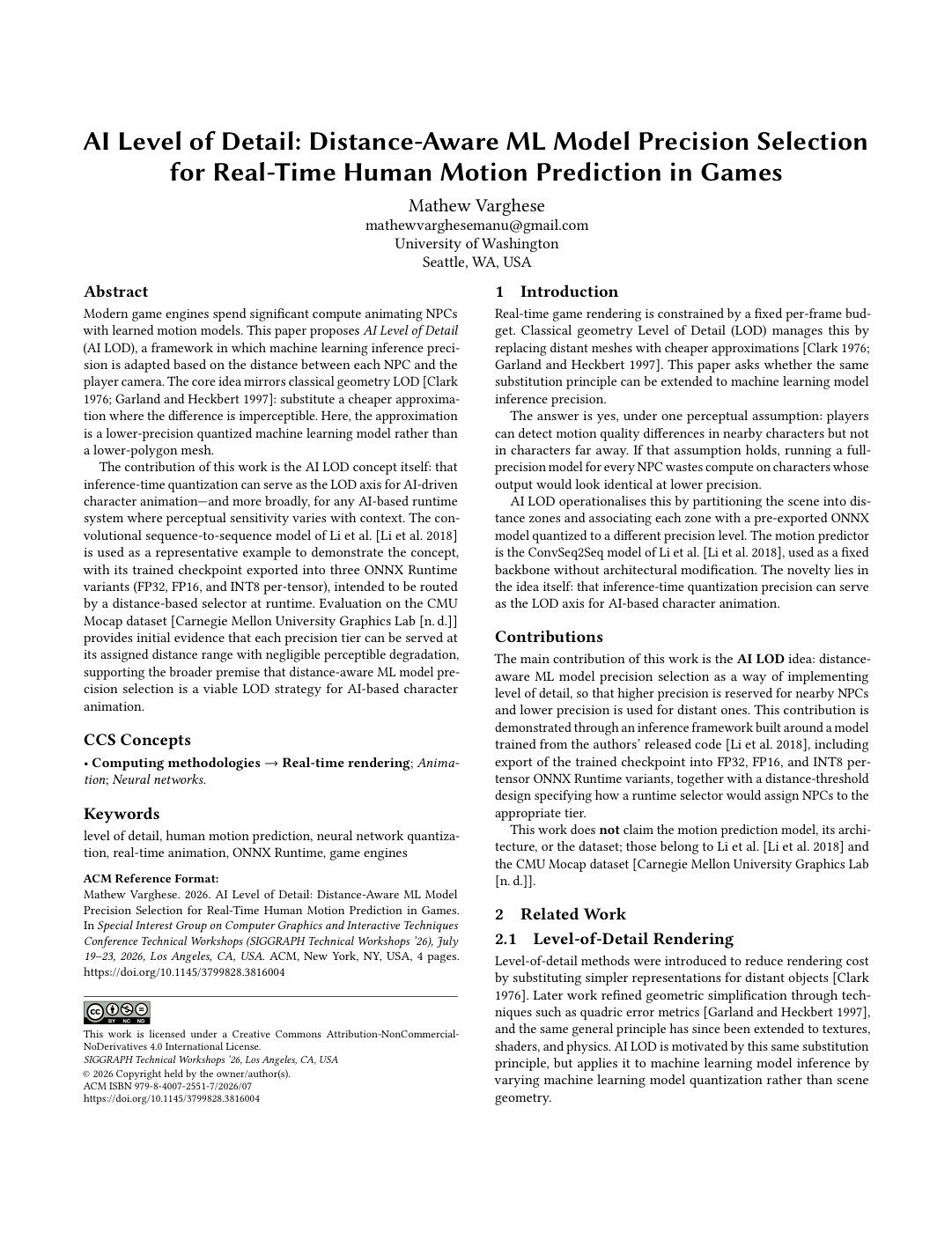
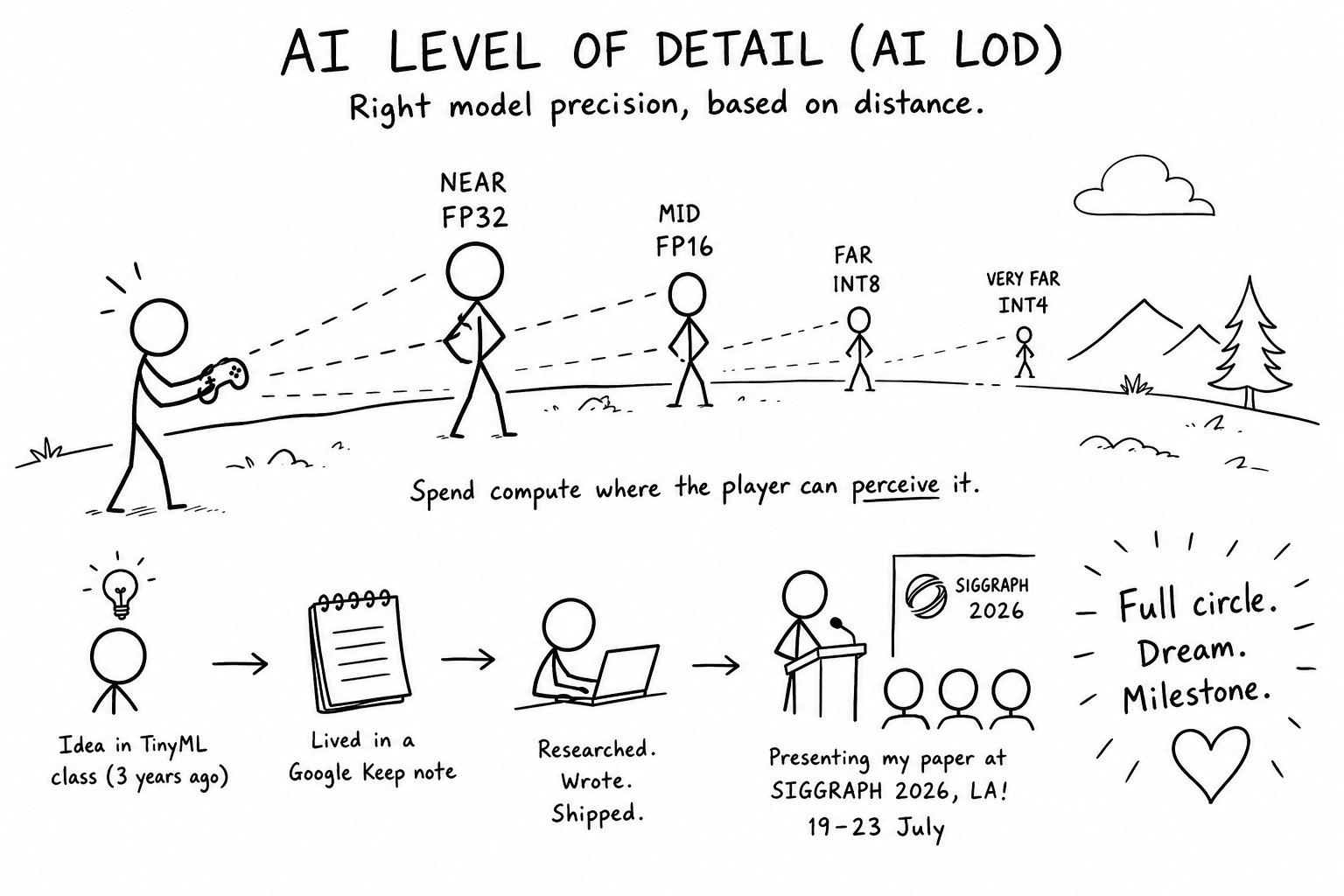
AI Level of Detail (AI LOD) extends the classic geometry level-of-detail idea to machine learning inference. Just as a game engine swaps a distant mesh for a cheaper one when the difference is imperceptible, AI LOD swaps a full-precision motion model for a cheaper quantized one based on how far an NPC is from the player camera. The novelty is the concept itself: inference-time quantization precision as the LOD axis for AI-driven character animation.
Using the ConvSeq2Seq human-motion predictor of Li et al. as a fixed backbone, the trained checkpoint is exported into three ONNX Runtime tiers — FP32 (closest NPCs), FP16 (mid-range), and INT8 per-tensor (farthest) — routed at runtime by a distance-based selector. The tiers are evaluated on the CMU Mocap dataset for latency, model size, and motion accuracy, alongside a small perceptual study.
Key results (CPU, vs FP32 baseline):
- FP16 — 1.53× faster, 49% smaller, near-zero accuracy loss (relative L2 7.8e-4).
- INT8 per-tensor — 9.79× faster, 73% smaller, with degradation that stays below the perceptual threshold at far distances.
A 15-participant perceptual study found no detectable difference when each tier was viewed within its intended distance range, supporting the core premise that distance-aware precision selection is a viable LOD strategy for AI-based animation.
Venue
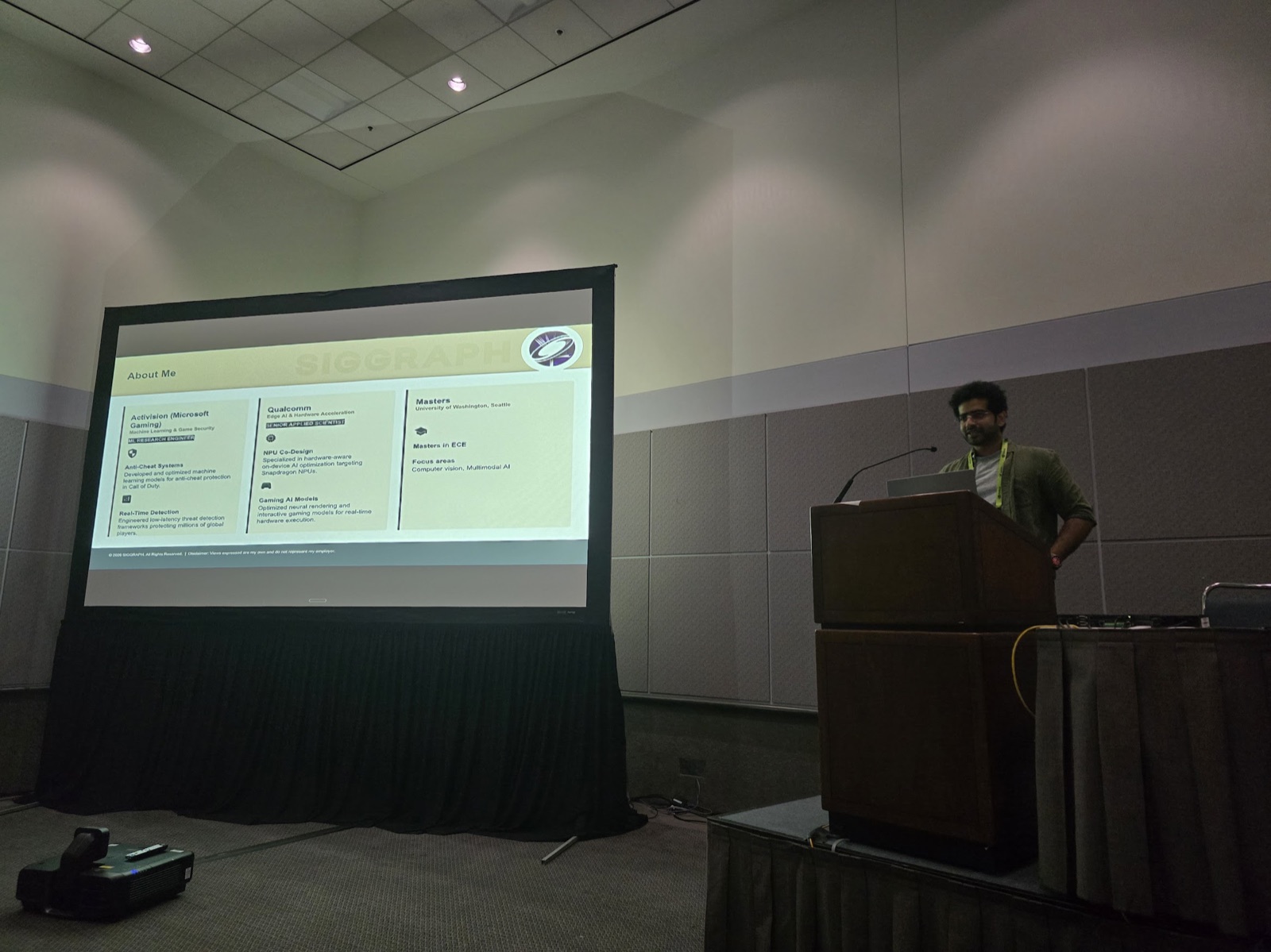
Presented at the PRICE Workshop (Performance, Rendering & Interaction in Competitive Esports), SIGGRAPH 2026 Technical Workshops — Los Angeles Convention Center, July 19–23, 2026. Talk given in Technical Sketch Session 2 on Thursday, July 23, 2026.
Photos
Links
| Resource | Link |
|---|---|
| Paper (ACM Digital Library) | dl.acm.org/doi/10.1145/3799828.3816004 |
| Preprint (arXiv) | arXiv:2606.06565 |
| Download (hosted copy) | |
| Presentation slides | Google Slides deck |
| Workshop schedule | price-workshop.org/2026/schedule/ |
| LinkedIn post | linkedin.com/posts/mathewvarghesemanu |
Citation
Mathew Varghese. 2026. AI Level of Detail: Distance-Aware ML Model Precision Selection for Real-Time Human Motion Prediction in Games. In Proceedings of the Special Interest Group on Computer Graphics and Interactive Techniques Conference Technical Workshops (SIGGRAPH Technical Workshops ’26). ACM, New York, NY, USA, 1–4. https://doi.org/10.1145/3799828.3816004